Guide
How to Use Technical Analysis to Make Smarter Financial Decisions
While easy access to market data may feel like an advantage for investors, the sheer volume and variability of information can be overwhelming, making it difficult to research with confidence. Complicating things further, financial news and media personalities often overload their audiences with conflicting opinions, market analyses, and forecasts. This makes it even more difficult to determine the accuracy and reliability of their conclusions due to potential bias or limitations in methodology.
In this guide, we’ll explore how an understanding of technical analysis can help you perform your own market research, better navigate volatility, and become a more confident and data-driven investor.
Technical Analysis:
A Method for Extracting the Signal from the Noise
There are generally two schools of thought when it comes the study and analyze of financial markets. The first is Fundamental Analysis (see more on this below). The other is Technical Analysis.
Technical Analysis is the study of trends and patterns in market price movement to identify potential investment and trading opportunities. There are many different technical studies and indicators available to use - some rather simple while others can be more complex.
The proprietary models that power the Socrates Platform are based on the principles of technical analysis. So let's take a slightly deeper dive on this topic.
Technical analysis methodology is primarily based on three core assumptions:
- Market history tends to repeats itself to some degree (behaviors, not necessarily results).
- Price moves in trends, patterns and even cycles — as opposed to being random.
- The latest price of a stock or other financial instrument accounts for relevant information, including market psychology. This assumption is referred to as ‘the market discounts everything’.
These assumptions suggest that financial markets operate in a cyclical manner, with prices moving up or down in a trend. As the market repeats itself, historical data helps us observe how supply and demand for a security may affect changes in price, volume, and volatility.
In other words, by employing technical analysis, we can make more informed investing and trading decisions by comparing current market conditions and behavior with historical precedent.
While there is no way to always "win" in the market, the more skilled you become at technical analysis the better positioned you’ll be to understand market trends over time — which may help you more easily anticipate potential market shifts. You can also use technical analysis to help minimize risk by identifying exit points that may make sense for you if the market doesn’t behave as you expect it to.
Technical Analysis vs. Fundamental Analysis
In many circles, technical analysis is often unfairly contrasted with fundamental analysis, as if §you have to choose one approach or another. But this is not necessarily true. As long as the user understands the differences, they can be combined to inform decision-making.
Primarily used in relation to stocks, fundamental analysis assesses how a company is performing from a financial perspective at a given point in time, especially compared to similar companies. Fundamental analysts aim to measure a security’s intrinsic value by studying macro and micro factors that can be impacting a company’s performance, such as then-current economic conditions, industry trends, cost of goods, sales and marketing, and company management, among other considerations.
Technical analysis on the other hand is more focused on the stock performance itself — regardless of what might be impacting it at any given point in time. Technical analysts believe that the reactions from fundamentals are already reflected in the price and are generally short-term in nature, so studying price movement over time can provide broader historical context and help identify possible trends and patterns you may otherwise miss.
How to Apply Technical Analysis to Data

To study market behavior, technical analysts have developed tried-and-tested signals and studies that use market data are often applied to charts. Collectively, these techniques are known as technical indicators. These technical indicators are designed to help reveal a market's behavior and whether a security may be worth buying or selling at any given time.
As a best practice, users should always study various technical indicators and backtest different strategies. It is also highly recommended that analysts consult with a certified financial professional before making any financial trade or investment.
Generally, there are two types of technical indicators used with a price chart:
- Overlays — these are placed on top of the price chart, providing a convenient means of visually comparing price movement against trend direction, trading range, as well as support and resistance levels.
- Oscillators — these are momentum indicators that are typically placed below a price chart and fluctuate between positive and negative territory within a range. They are used to help identify potential overbought or oversold market conditions.
Investors are spoiled for choice when it comes to the variety of technical indicators. To get started, it is best to familiarize yourself with how they each work and which might align with your research approach best. The technical indicators below introduce some core concepts, highlight some commonly used studies, and provide some examples that illustrate how technical analysis is performed using the Socrates platform.
Learning Technical Analysis
To learn how to apply technical analysis, you need to understand the core concepts. There are many free and paid-for books, educational websites, and courses that cover this subject. But be cautious of bold promises. Financial markets are risky and while learning how to conduct technical analysis can help better understand market movement, it will not eliminate risk.
Once you understand the theory behind technical analysis, develop your practical skills through backtesting and paper trading. Backtesting allows investors to simulate a strategy using historical data to generate results, while paper trading simulates stock market trading without needing to invest your money.
Identifying Trend Movement with Moving Averages
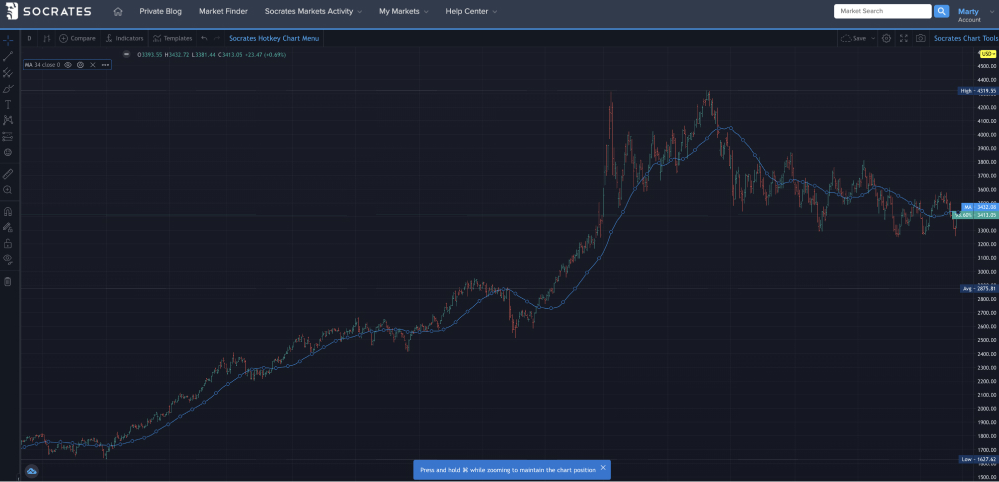
One of the most commonly used indicators, Moving Averages (MA), identify trend movements by averaging out price fluctuations over a period of time. Visually, this converts jagged lines on a chart into smooth and easily understood patterns. Moving Averages are often used to identify trend direction and to help identify potential support and resistance levels, with averages taken over a specified time, such as 10 days, 10 weeks, or 10 months.
Generally, if the price is above a moving average, it is a simple indicator that the trend may be up (or, bullish). If the price is moving below a moving average, it suggests the trend may be down (or, bearish). The figure below is an example of a moving average chart, with the smooth line representing the price averages for the period.
Measuring Momentum With Stochastic Oscillators
Stochastic oscillators measure the closing price of a financial instrument or security to a range of its prices over a certain period of time. This indicates the momentum of an asset’s price and helps identify potential trends and change in direction.
Stochastics measure momentum on a scale of 0 to 100. Above 80 is typically interpreted as an indicator of being overbought, while measurements below 20 are generally considered an indicating it is oversold.
Stochastics are grouped into two categories: "fast" and "slow". The main difference is that the fast stochastic is more sensitive to changes in the price than the slow stochastic, which is why both are typically presented together in an effort to balance out the picture.
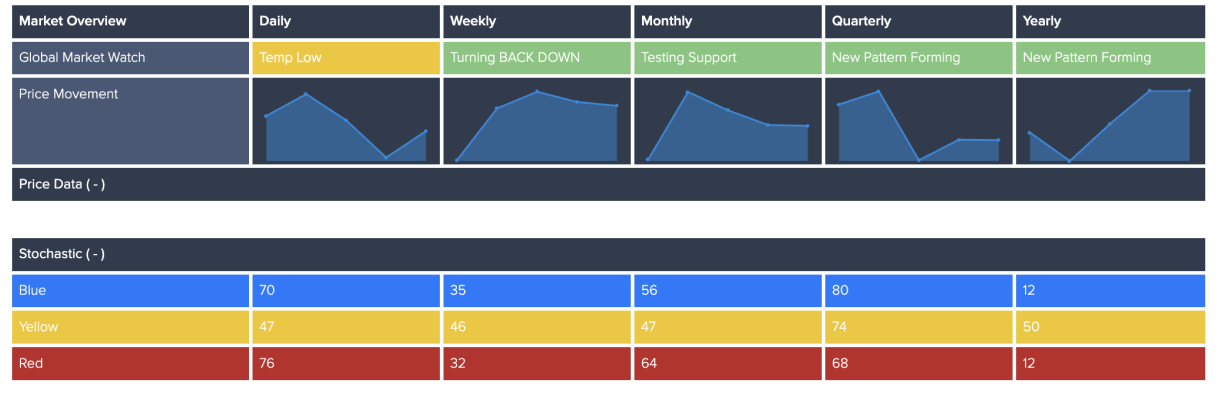
In Socrates, we provide stochastic values across a number of different time levels so the user can better understand what might be a short-term vs long-term reading of momentum. The illustration below is an example of stochastic values across Daily, Weekly, Monthly, Quarterly, and Yearly time levels in one of Socrates data tables.
The Stochastic Oscillator Formula
The standard period measured is 14 days, but this can be adjusted depending on your research needs. The typical stochastic oscillator is calculated using the following formula:
%K = (Last Closing Price – Lowest Price)/(Highest Price – Lowest Price) x 100
%D = 3-period Moving Average of %K
Here, %K is the fast stochastic (blue), while %D is the slow stochastic (red).
In addition to a fast and slow stochastic, the Socrates Platform includes a third stochastic (yellow). This is an additional study to see if or when the fast and slow stochastics align, with the potential to create a stronger signal.
Gauging Trend Strength With the Relative Strength Index (RSI)
Like the stochastic oscillator, the relative strength index (RSI) uses a range from zero to 100. RSI is used to measure recent price gains versus recent price losses, which makes it valuable in determining trend strength. RSI can be used to assess:
- Whether a security may be overbought or oversold — when RSI moves above 70, it is considered overbought. When RSI is below 30, it is considered oversold.
- Divergence — when the indicator is moving in a different direction than the price, it shows that the current price trend is weakening and may soon reverse.
- Support and resistance levels — during uptrends, a stock will often hold above the 30 level and could reach 70 or above. When a stock is in a downtrend, the RSI will typically hold below 70 and could reach 30 or below.
Complement Stochastic and RSI Studies with the Energy Model
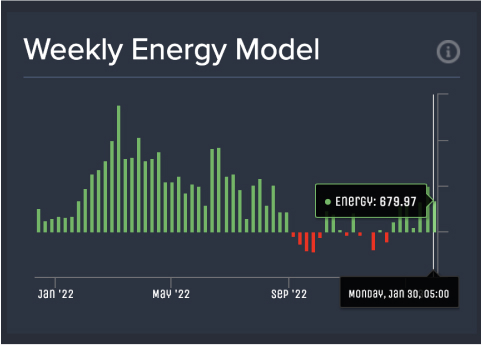
Socrates Platform users who study markets using Stochastics and the RSI can add the Energy Model into the mix. The Energy model is a proprietary model that analyzes the relative push-and-pull force between the bulls and bears in a covered market, offering a unique computer-generated assessment of how much energy (strength) remains in a market's current price movement. When studied in conjunction with Stochastics, the RSI and even Moving Averages, the Energy Model can offer a complementary point of reference in your study of a market's price movement.
The illustration here shows the Energy Model within the Socrates Platform.
Discover Market Pressure Points With the Reversal System
The Reversal System is a proprietary computer model designed to identify price points in which pressure can build, potentially leading to a market trend change. These pressure points are also known as Reversal points.
The concept is simple — when enough pressure builds up in either direction (up or down), there will eventually be a point at which, if exceeded or penetrated, energy releases, causing a shift in the other direction.
The computer model generates new Reversal points each time an isolated high or low occurs in the market. When a Reversal point is breached on a closing basis — when the market closed above a Bullish Reversal, or closed below a Bearish Reversal — it is considered “elected”. It is important to understand not all Reversals are created equal, thus not all elected Reversals are equally significant. Many elected Reversals serve as a signal that a current market trend will continue, while other elected Reversals may represent a possible turning point and change in trend in the opposite direction. Continuous study of elected Reversals, and the related timing and conditions, can help users to better understand the potential behavior and movement of a market.
For example, imagine a scenario where a market has been in a long-term uptrend but appears to be losing momentum (overbought). In this instance, it is near a notable level of technical resistance when it elects (closes below) a monthly Bearish Reversal. This may indicate the market has reached a peak level of pressure and is about to reverse into a downtrend.
Conversely, imagine a market that has been in a long-term downtrend but appears to be reaching an oversold state. This market is near a notable level of technical support when it elects (closes above) a monthly bullish reversal. This may indicate that the downtrend pressure breaks, and the market may reverse into an uptrend.
These examples illustrate the basic concept of the Reversal System. But more study is needed to understand the potential importance of any such elected Reversal. Combining other technical analysis methods, such as tracking moving averages and momentum, will help you understand the reasons underlying a Reversal.
The red and green lines in the example monthly price chart below depict monthly Reversal points, as shown in the Socrates platform. These price levels can be studied as possible areas of technical support or resistance in the market
As mentioned earlier, it is best to utilize multiple indicators and studies as part of your research. Within the Socrates Platform, members can analyze Reversal points alongside other data points, models, and technical studies — including our unique Timing Arrays. This brings us to example number 5.
.png "Monthly Reversals")
Track Market Cycles With Timing Arrays
Socrates’ Timing Arrays are a collection of dozens of different computer models that — both independently and collectively — monitor the cyclical nature of a market as it progresses through a unit of time (e.g. a day, a week, a month, etc).
Each model in the Timing Array assesses the market from a different perspective. To simplify this for users, the Socrates Platform includes what is called the Aggregate model, which is a sum of the output across all of the cyclical models in the Timing Array. This is typically the focal point for most Socrates members.
In order to study the Timing Array table it is important to understand that each row represents output from a unique model in the collection. For example, the Directional Change model output takes up one row of the table, while another row is dedicated to the Panic Cycle model. Each column represents a unit of time such as a day, a week, or a month. The table is designed to easily identify when activity from the models aligns with a given unit of time.
Examining the Aggregate row below, when the height of a bar in this row aligns with activity from other rows in the same column (or time unit), it can signal the possible timing of a market event, such as changes in trend, volatility or a turning point.
.png "Monthly timing arrays")

TIP: It is important to align research of activity observed in the Timing Arrays with other technical studies such as momentum indicators or the Reversal System. This is the study of time and price.
Identify Market Closing Condition With Indicating Ranges
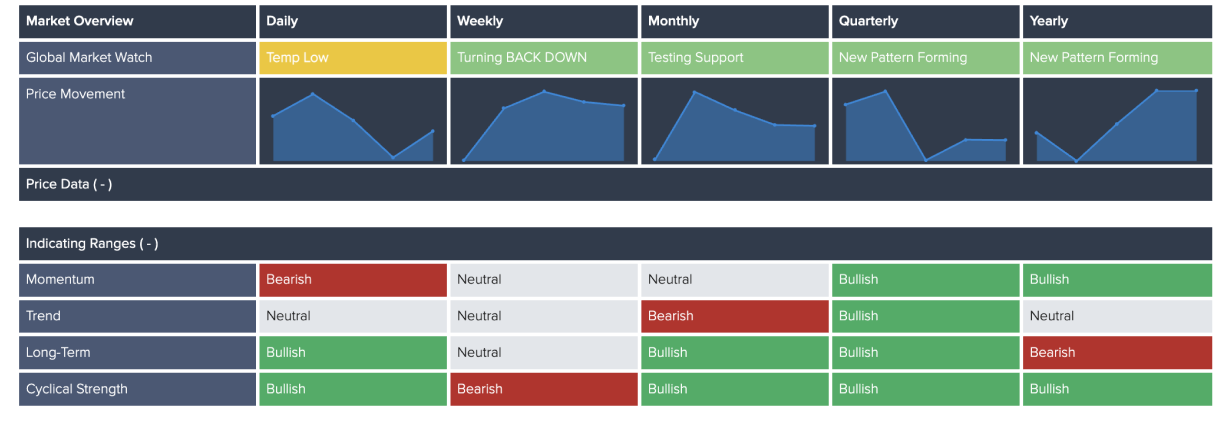
Indicating Ranges are yet another collection of proprietary indicators found within the Socrates Platform. Indicating Ranges assess each market's relative price strength or weakness on a given point in time — specifically upon closing of a unit of time, such as a week or month. The output is a simplified readout indicating bullish, bearish, or neutral conditions across four key viewpoints: Momentum, Trend, Long-Term and Cyclical Strength.
The illustration below depicts a readout from the Indicating Ranges for how the models observe a given covered market’s condition. The readout represents the last closing on a daily, weekly, monthly, quarterly, and yearly time frame.
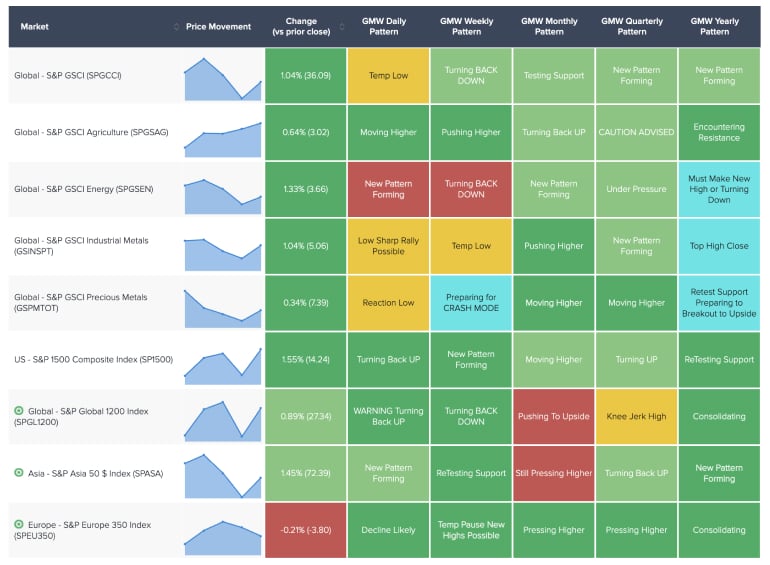
Study the Big Picture With the Global Market Watch
Market research platforms typically give you access to sector or industry dashboards that use red and green colors to reflect current price movement. The Socrates Platform uses a similar bird’s eye view concept, but also includes the unique Global Market Watch (GMW) indicator. GMW is a pattern recognition computer mode that analyzes the price movement of every global financial instrument that is available to research within the Socrates Platform.
While the GMW is robust on the backend, the frontend output is formatted with a simplified color and comment design. These colors and comments are generated to help translate the patterns or trends the model identifies. This way, GMW provides an easy reference tool that enables users to recognize areas they may want to research further.
Growing Your Wealth Through Technical Analysis
If wielded correctly and with discipline, technical analysis is an effective method of researching markets, helping you make better decisions to grow your wealth over time. But remember that the best approach to technical analysis is to combine multiple technical indicators into your study, practice your skills, and challenge your thesis with additional research until you can validate it.
But no methodology or approach to financial market analysis is a silver bullet that eliminates risk. It is also recommended that individuals always work with certified financial professionals before making any financial investment or trade.
The Socrates Platform offers access to proprietary computer models that apply technical analysis methodologies, and market research tools intended to make it easier to identify areas of potential activity or opportunity. This includes our unique computer-generated analysis text, which can help highlight signals, patterns, and trends. This creates opportunities to further research what the models may be identifying within the data.
Designed for a global audience, the collection of proprietary computer models behind the Socrates Platform have been developed over decades and have a long history of delivering data-driven, unbiased information for institutions and industry professionals.
Want to learn how Socrates can support your technical analysis and market research?
Explore our Membership Plans to find a version of Socrates that works for you.